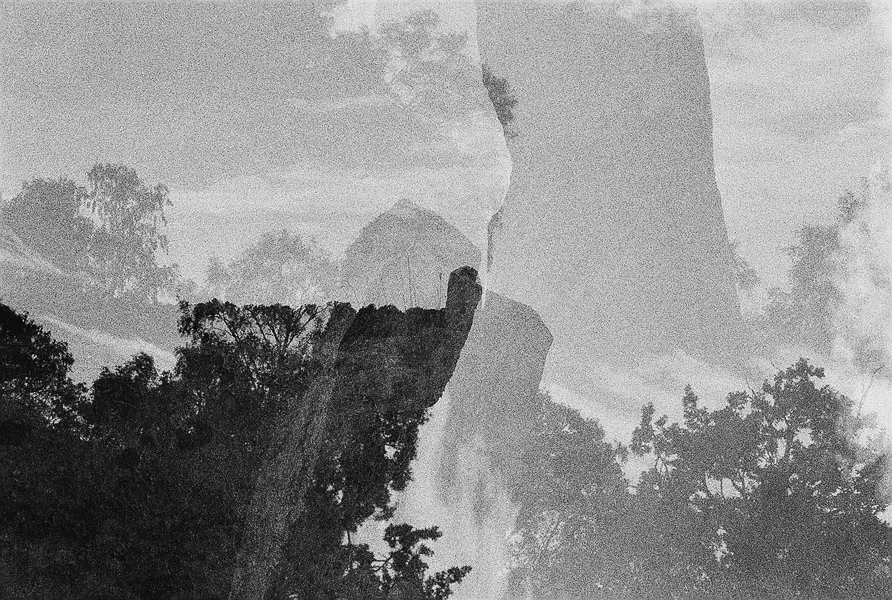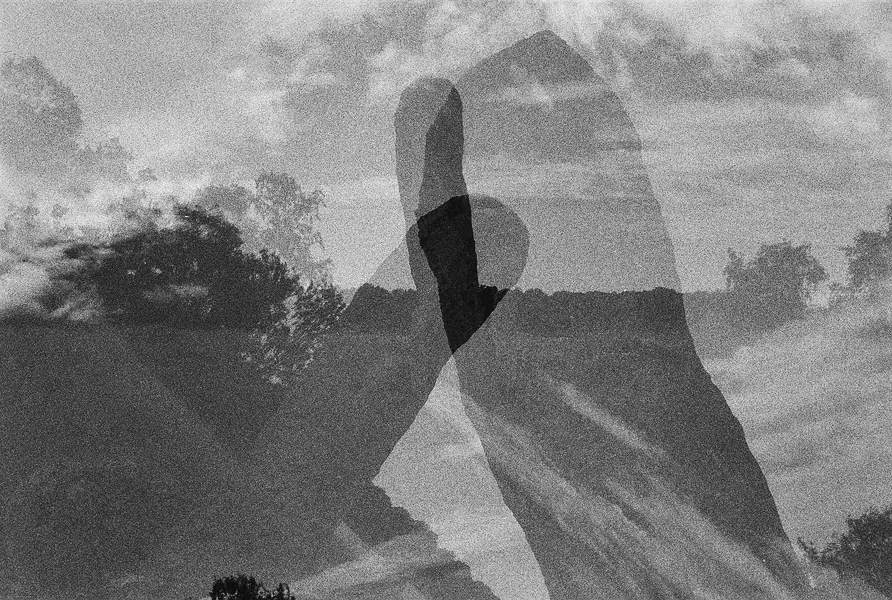
Steady rains pass the Equinox. Turning soggy firth and fold. Bent bunch-grass and windlestraw matt the wooded edges spared the scythe. Fae fog-drifts over lowlands.
‘Over centuries, as they turn up the earth, earthworms gradually bury Roman bathhouses, drystone walls, ancient edifices. […] Monoliths do not collapse, but are quietly, incrementally sunk.’1
August Strindberg’s 1901 painting, Inferno-Tavlan, adorning the cover of my bedside copy of his Inferno Diary
A band of roughly daubed leaves coalesce into a shadowy enclosure over a stormy grey sky, pouring rain, a mottled landscape or seascape with sea-green hills or waves, swashes of vermeil red around the fringe
Encaverning a recurring obsession for Strindberg, the motif appearing first in his 1892 painting, Underlandet, depicting a pale light glowing maidens-blush amid a field of variegated deep greens and browns, scarce shell-pink flowers scattered above a darkening patch or pool
Strindberg’s attempt to paint the sea through the forest unintentionally rendered as a hollow opening onto a luminous realm of,
‘disembodied and undefined beings.’2
In the bedroom I drag my head out from under the duvet, my sleep interrupted by the insistent alarm call of small passerines — blue tits, crested tits, great tits, long-tailed tits, marsh tits, willow tits — tap tap tapping at the facade of the house
Rebecka shouting enthusiastically from the kitchen,
“Are you awake? Summer’s almost over!”
I reach blindly to the floor plunging my hand into a pocket of cold air up from the foundation
Only a few wood-boring beetle tracked timbers between me and the granite underlair of snakes and toads
06:33, your phone updated overnight, a single email notification,
‘Summer isn’t over deals inside!’
Mark as spam
‘I got up at 5 o’clock and saw the sun rise in a marvellous sky. A bright heart of light with a green rim fell on my bed three times.’3
I rise and eat Sinangag, a garlic fried rice dish popular in Singapore, I serve mine with two eggs from the local rekoring, one of the cracked shells a speckled white the other a watery blue
When we miss the rekoring and instead collect the eggs in person — arranged in crates alongside potatoes and root veggies in a refrigerated shack on the side of the road — me and Rebecka watch a half-dozen children racing bikes around a massive farmland followed by a bounding white shepherd
On the kitchen table — the smaller of our two 1950s Edsbyverken4 — I make room for my breakfast bowl and coffee mug by carefully moving the toilet paper sheets speckled with dried tomato seeds with their heirloom names labelled in laddered biro
Brandywine Yellow, Canestrino di Lucca, Cherokee Purple
My wooden cottage chair creaks as my weight presses one of its back legs into a rattletrap floorboard that we’ll eventually have to fix, a groan from the pump and an iron orange spurt from the tap as the drought depleted well struggles to provide water through settled layers of minerals and sediments
In the underwood, leaning on a tumble-down cottage swimming in sunlight. Squashing bushy hassocks where the soggy water lies.
1894-1896, August Strindberg enters his self-mythologised ‘inferno crisis’ — the wilderness years of self-torment in Paris and Austria
‘Have I lost myself in a dark wood? […] Altogether worn-out after a sleepless night and new conflicts with the Invisible, I curse life, and lament that no sun shines.’5
Harried by unseen antagonists6 Strindberg begins to believe himself oppressed by weather as revelatory portent, perceiving sparks, static and thunder as direct manifestations of divine and demonic forces, drawing him into,
‘a cosmic drama where everything he observed, perceived and experienced bore witness to hidden connections and contained messages intended only for him.’7
It is with this increasingly anxious mindset that Strindberg performs his various chemical — metals and solutions — experiments in an attempt to ‘cultivate gold’, and to control or divine the various atmospheric forces. This ‘great work’ beginning in semi-seclusion in Paris in,
‘a miserable, unheated little room with a view of a dirty wall. A very simple iron bed in a sloping alcove, and in the middle of the floor a table piled high with papers, newspapers and various tools; on a marble fireplace several bottles lined up, and on the window a few small porcelain crucibles.’8
Before relocating to an isolated alchemical laboratory in an alpine forest in the village of Klam, Austria,
‘a landscape identical with the one I saw in my Zinc basin at the hotel Orfila […] (The) Swedenborg description of hell resembles in every respect Klam.
Hell is among Mountains, Hills, Valleys, Plains, with caves
Lost souls cannot abide daylight or pure air. Vanity, hate, envy.
Sloping caves, arches, cellars among dilapidated buildings.’9
I button up my long black rubber raincoat and step off the stone porch into bog, flosh, slash
I take cautious steps to the big falu barn to unplug the electric fence, erected as a temporary wild boar deterrent, humming softly around the outside of our partially collapsed stone border wall
The night of welcome lashings has broken to a heavy mist morning, the mountain washed clean, strung out to dry in the grey dawn
I pause in the barn doorway to listen to the trickling gutters, the splashing rain-butts, the occult rainfall10 coming down from the forest
On the ground inky pools on the surface as the water seeks purchase through the bedrock below
Two long strides at a time back to the porch, the garden sucking at muddied boots
Each step giving with a strain, a slup
‘It is then no acoustic hallucination from which I suffer; everywhere there are plots […] It is the Devil himself! Hunted from hotel to hotel, pursued everywhere by electric wires even to my bed, attacked everywhere by electric currents which lift me from my chair […] the weather is terrible […] The earth is dirty, the sea is dirty, and dirt rains from the sky’11
Me and Rebecka sit at the living room table — the larger of our two 1950s Edsbyverken — in a pool of light from a green glass shoemakers lamp
We’re surrounded by unlit candles and waiting for the power to drop, our palms resting on the tabletop in the calm before a séance
Waiting for sprit raps, waiting for ectoplasmic materialisation
All the while pasted onto window panes wet lime and maple leaves — turning red turning gold — peeling in gusts
A plastic rain butt lid lifting and skipping over mulched potato patch, wedging itself between browning ivy-clad cherry boughs
A resounding crack announcing a fallen spruce
Front doors rattling in their frames